How Close Can Trees Grow to a Pool Cage in Naples?
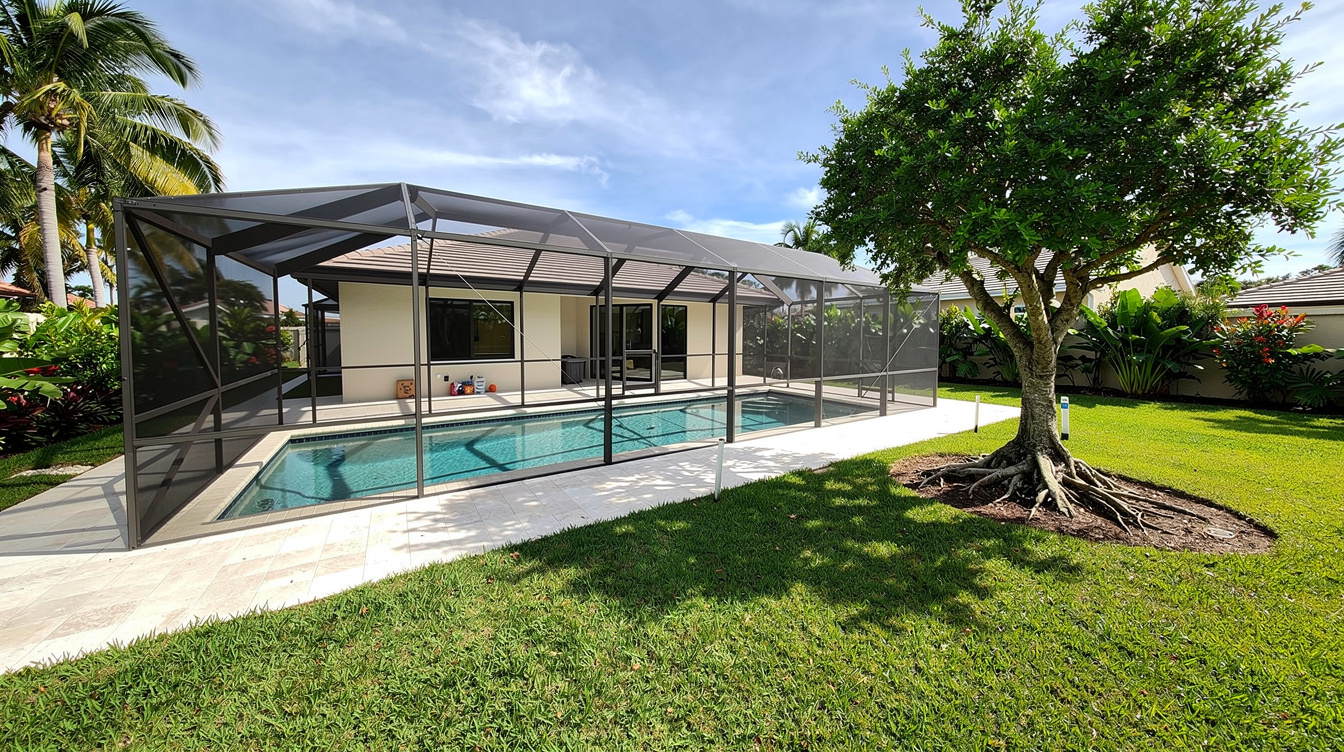
For trees near a pool cage in Naples, start with at least 10 feet of separation and allow more room when the mature canopy or roots call for it. That distance is a landscaping starting point, not a guarantee that the cage will stay clear of branches or roots.
The right spot depends on the tree you choose and the space around your enclosure. A small tree at planting can eventually shade the pool, crowd a screen panel, or make repairs harder. Start by planning for its mature size.
Key takeaways
- UF/IFAS recommends planting shade trees at least 10 feet from pools, foundations, walls, and curbs.
- Add space for the mature canopy and a clear maintenance path around the cage.
- Roots can grow well beyond the branches, so canopy clearance alone doesn't protect a footing.
- Local tree rules and HOA requirements are separate from practical planting recommendations.
How to measure space for a tree near your pool cage
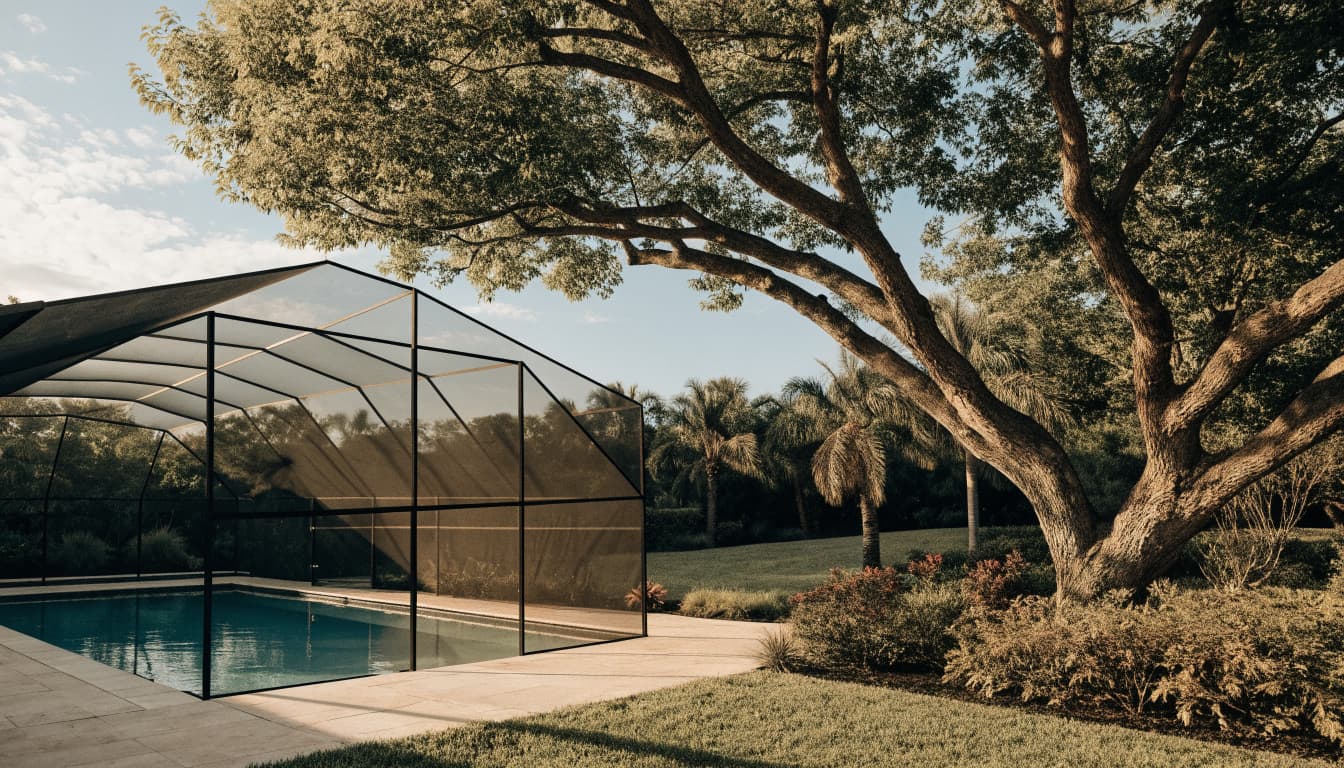
The University of Florida Institute of Food and Agricultural Sciences, or UF/IFAS, recommends keeping shade trees at least 10 feet from pools and other structures. For a pool cage, use that as a starting point when considering the nearby deck, enclosure supports, and footing.
The recommendation isn't a cage-specific setback. A tree that grows broad branches may need much more space, while a smaller ornamental tree may fit a yard where a large shade tree won't.
Start with mature canopy width
A practical way to estimate branch clearance is to divide the expected mature canopy width in half. That gives you an approximate canopy radius to plan around.
For example, a tree expected to spread 24 feet may extend roughly 12 feet from its trunk. If you also want a 3-foot working gap between the foliage and the cage, place its trunk roughly 15 feet away. That's a planning estimate, not a promise that every branch will stop there.
Leave room for growth on every side
Trees don't always grow as neat circles. Sun exposure, neighboring plants, and pruning can affect their shape. Give the tree extra room if it naturally leans or spreads toward the enclosure.
Also consider the roof, not just the side panels. An overhanging limb can drop debris onto the screen even when the trunk is well outside the cage perimeter.
Account for roots as well as branches
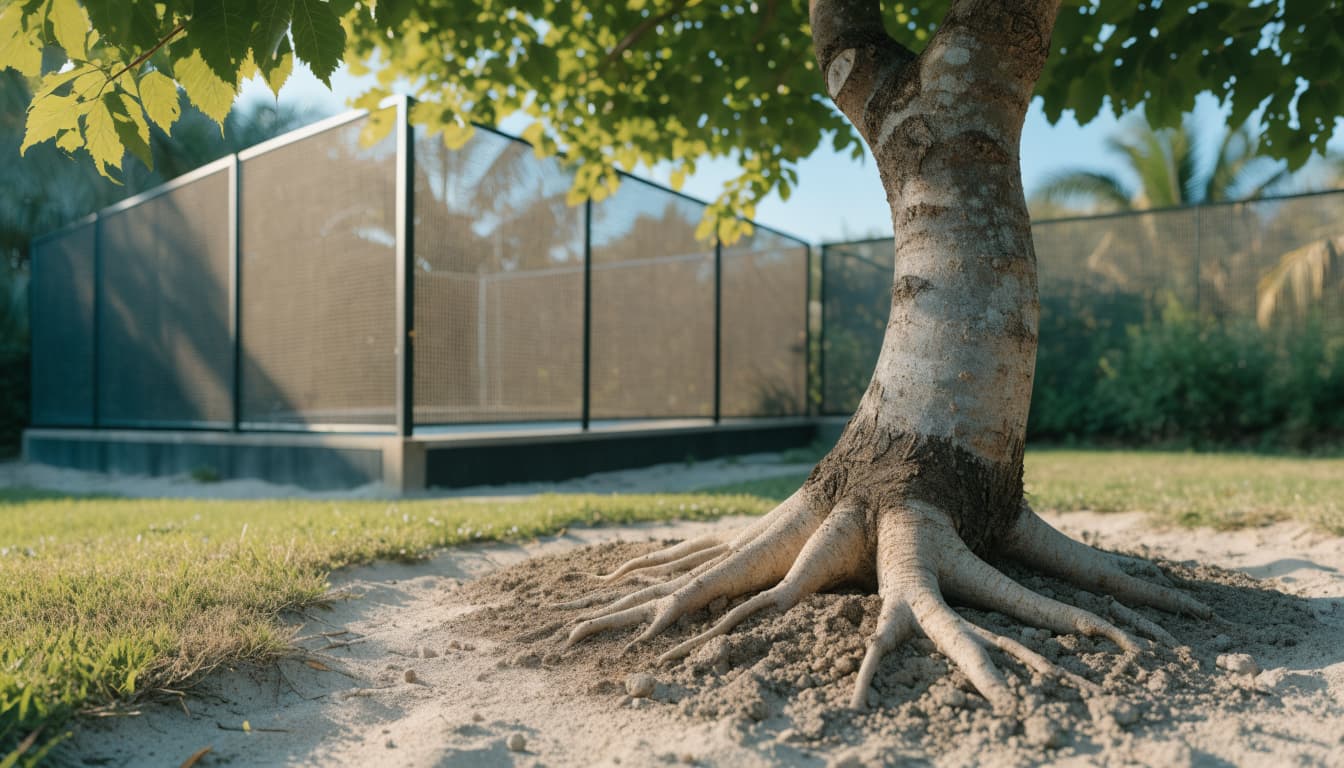
Branches are easy to see, but roots deserve attention before you plant. They can extend well beyond the canopy, including into the area beneath paving or near an enclosure footing.
Roots don't stop at the dripline
The dripline is the outer edge of a tree's branches. UF/IFAS notes that roots of landscape trees and shrubs can extend to three times the branch spread within two to three years after planting.
That doesn't mean roots will damage every nearby structure. It does mean a tree can look comfortably separated above ground while its roots occupy a much wider area below. Soil conditions, available moisture, species, and existing hardscape all affect growth.
Protect the footing and the tree
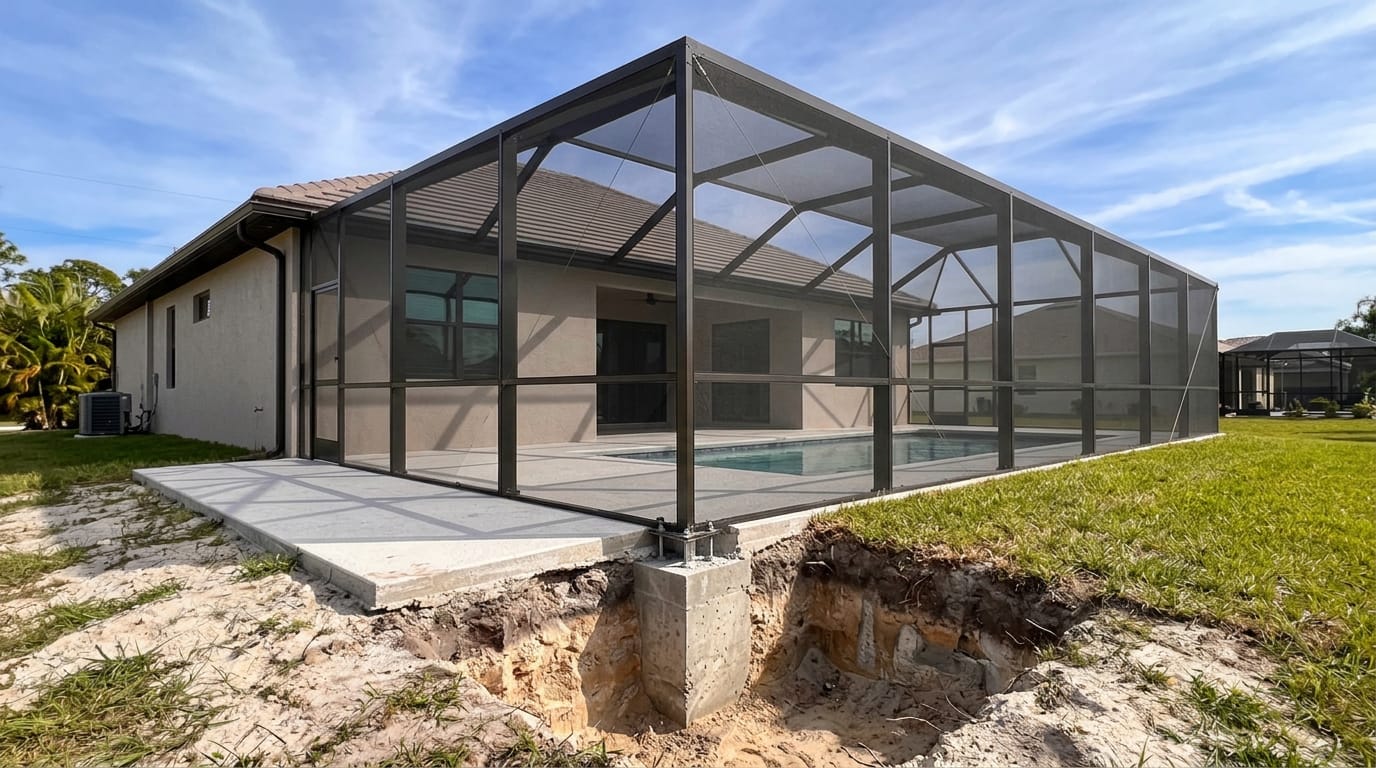
Look beyond the screen itself when choosing a planting spot. The cage may have posts and supporting construction close to the deck, while pool plumbing and other utilities can occupy nearby soil.
Avoid cutting substantial roots merely to make room for paving or repairs. Root loss can affect a tree's health and stability. If a mature tree and a cage footing are already competing for space, an arborist can assess the tree before excavation begins.
Choose trees for the space they'll have
A good choice for a Naples yard fits the available planting area without constant cutting. It should also offer the shade or view you want without creating a maintenance problem beside the pool.
Consider smaller ornamental trees
For a tighter yard, consider a smaller tree or a plant that can be maintained in tree form. Simpson's stopper and silver buttonwood are Florida-native options to consider for a landscape design. Their suitability still depends on the plant's eventual size, the site, and the space available.
Keep the trunk far enough away that branches can grow without pressing on the cage. A compact planting area also needs room for the tree's root system and access around the enclosure.
Smaller doesn't mean maintenance-free. Any tree can shed plant material, and even a modest canopy needs occasional attention as it grows.
Give large trees a larger planting area
Live oak offers substantial shade, but its size makes it a poor fit immediately beside many pool cages. UF/IFAS lists a potential canopy width of 60 to 120 feet under suitable conditions.
A young oak can look manageable near a new enclosure. Over time, however, its broad canopy can extend over the roof and occupy a large share of the yard. If you want a live oak, plan for it as a major landscape feature rather than a close-in poolside accent.
Bald cypress also deserves careful placement. Its knees can rise above the soil, making it a less convenient choice close to paving and walking areas.
Consider leaf, fruit, and branch drop
A tree doesn't need to touch the cage to create extra work. Leaves can settle on a screen roof, particularly where sloping sections meet or debris catches against framing. Fruit and small branches can add weight or leave residue.
Southern magnolia is one example to consider carefully: UF/IFAS identifies its large leaves and fruit as a cleanup concern. Carambola, also called star fruit, can produce messy fallen fruit. Both may be attractive elsewhere in the yard, but placement near the enclosure affects how often you'll clean.
Consider the view as well. A tree positioned beyond a favorite poolside seat can provide shade and greenery. Placed directly against a panel, the same planting may block the sightline you hoped to preserve.
Keep access open around the screen enclosure
Tree placement affects more than the screen roof. Leave enough space to reach the outside of the cage, open doors, and work around posts without forcing branches against the mesh.
Make room for cleaning and repairs
A working gap lets you clear debris and reach screen edges. It also gives a repair crew space to work on panels and framing. Three feet is a useful planning allowance where the yard permits, though the space needed for a particular repair can vary.
Keep shrubs and low branches out of that path as they grow. A narrow passage may seem adequate on planting day but become difficult to use after several seasons.
Watch the frame and doorways
Branches that rub against a screen can wear or tear it. Contact with the frame is also a reason to look for damage, especially after strong winds.
From the ground, look for bent members, separated joints, shifting posts, and doors that no longer line up. Our guide to screen enclosure frame repair signs covers changes worth bringing to an enclosure professional's attention.
Keep exterior doors and their paths clear, too. Plants shouldn't interfere with a gate's operation or access to the pool area.
What to do when a tree is already close
An existing tree doesn't automatically need to come down because it's within 10 feet of the cage. Its size, condition, branch position, and relationship to the deck all matter.
Start by looking at the space between the branches and roof. Then inspect the surrounding paving and cage from the ground for changes such as lifted pavers, a bent frame, or screen panels separating at their edges. Those signs deserve attention, but they don't establish that the tree caused the problem.
For the mesh itself, distinguish a tear in the panel from a gap along its frame. Our guide to pool cage screens pulling loose explains what to look for.
If limbs are large, damaged, or difficult to reach, use an arborist rather than climbing onto the cage. A screen roof isn't a work platform.
Understand Naples tree rules and HOA requirements
The 10-foot starting point is practical planting advice. It isn't a statement of Naples law, and it doesn't replace a permit or neighborhood requirement.
City trees and county properties follow different rules
Within the City of Naples, the tree protection ordinance covers trees and palms on public lands. The City requires an approved Tree Alteration Permit before a City tree is altered, trimmed, disturbed, or removed.
Properties in unincorporated Collier County follow county rules rather than City of Naples rules. County materials distinguish cultivated landscape tree removal from removal involving protected vegetation. Its cultivated-tree permit provisions exclude single- and two-family home sites, although those sites must maintain the applicable minimum tree count.
HOA approval is separate
A neighborhood association may have its own landscaping requirements, including rules about plant types or placement. HOA approval doesn't replace a government permit where one applies.
A new or modified enclosure can also have its own building requirements. Tree placement and enclosure design should be considered together, particularly when a planned cage will sit near an established tree.
Frequently asked questions
Is 10 feet enough for every tree?
No single distance fits every tree. Ten feet is a starting point for shade trees near pools and structures. A broad canopy, extensive roots, or the need for maintenance access can make a greater distance sensible.
Can branches hang over a pool cage?
They can, but overhanging branches bring debris closer to the screen and may make roof maintenance harder. Larger limbs also deserve attention because a falling branch can damage the enclosure. An arborist can assess pruning needs without relying on the cage for access.
Will tree roots always damage a pool cage?
No. Roots can extend beyond the canopy, but their presence doesn't guarantee damage. The tree, soil, footing, and surrounding construction all affect the situation.
Give the tree and cage room to coexist
For Naples homeowners, mature size is the best starting point for placing a tree near a pool cage. Use the 10-foot recommendation as a baseline, then allow additional space for branches, roots, and access.
If you're planning an enclosure or dealing with damaged screens, we offer pool enclosure construction and rescreening. A layout that accounts for the surrounding landscape makes the space easier to enjoy and maintain.